
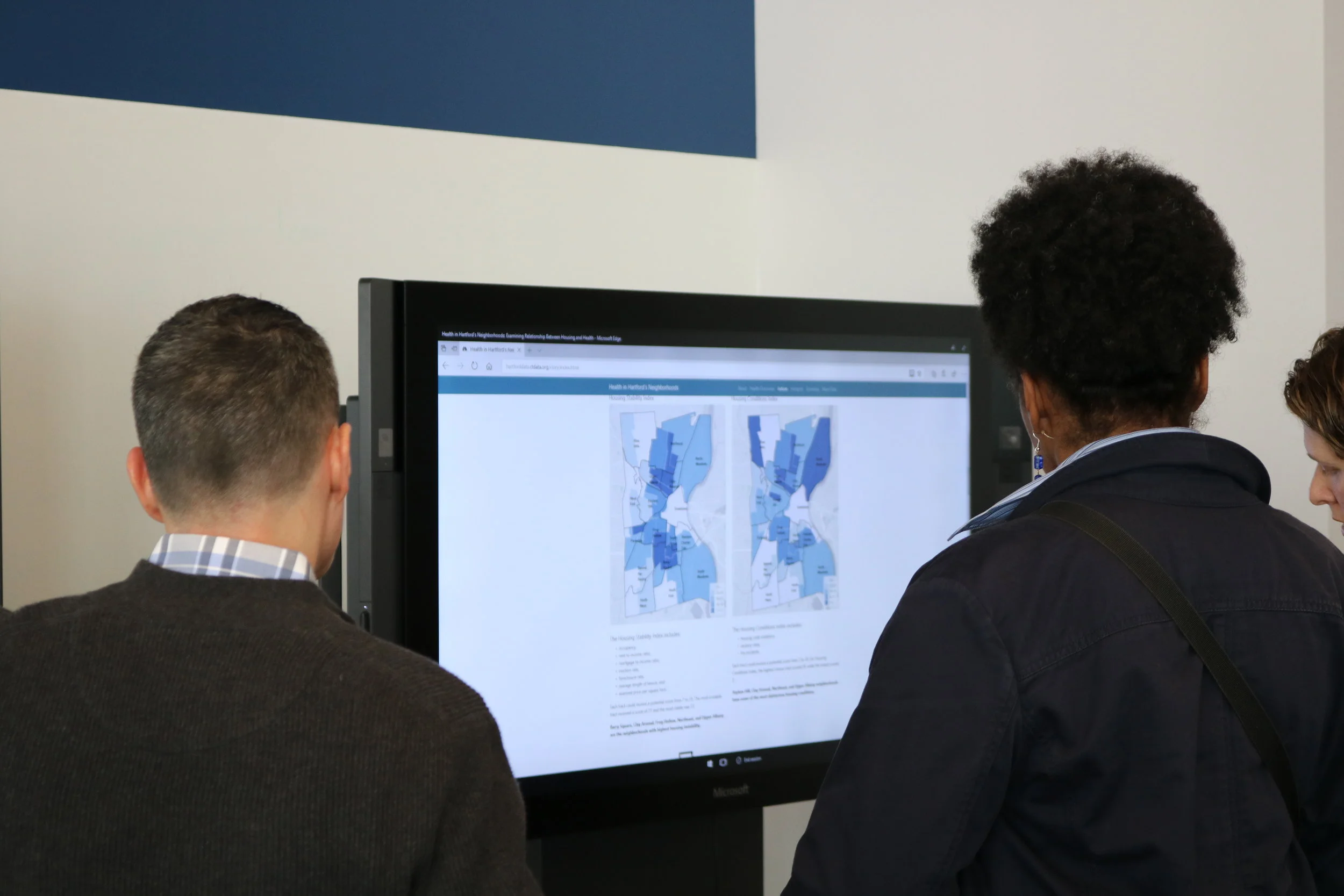
In partnership with the Urban Institute, the Robert Wood Johnson Foundation, and the Liberal Arts Action Lab, we are pleased to share our 500 Cities Data Challenge project that uses census-tract level data to address health disparities in our community.
The 500 Cities Data Challenge selected 10 organizations to receive funding for projects that will improve community health outcomes using the 500 Cities dataset. Over the past year, this cohort of grantees from across the country has leveraged local health data to address many social factors that influence health, including air quality, affordable housing, climate change, noise pollution, and public transportation.
Our project leveraged 500 Cities data to map the relationship between health and housing in Hartford.
-
CTData used 500 Cities data to examine the relationship between health and housing and understand the challenges faced by Hartford neighborhoods struggling most from disinvestment.
-
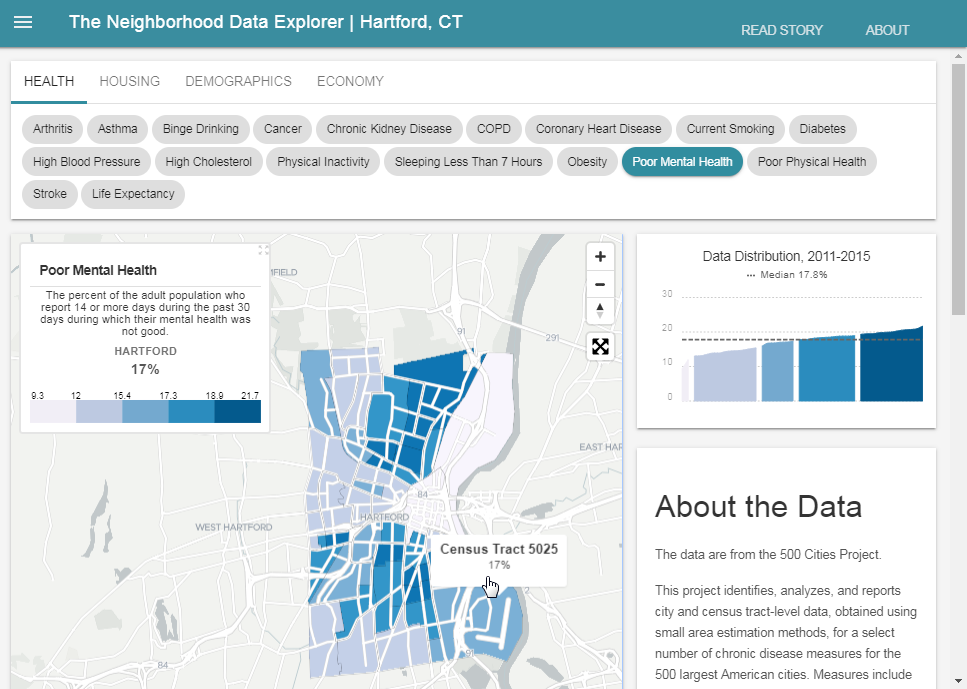
The team developed The Neighborhood Data Explorer, an online data platform that gives the public access to all the data used in the analysis and features many of the 500 Cities data health outcomes.
-
We also published Health in Hartford’s Neighborhoods, an interactive online story that walks users through our analytic approach to identifying the relationships between housing conditions, health outcomes, and neighborhood disparities.
-
CTData created two indices—a housing conditions index and a housing stability index—that allow the field to compare health outcomes with housing conditions and housing stability at the census tract level.
-
The team conducted an optimized hotspot analysis to identify significant clusters within neighborhoods needing public investment and employed a data dissemination strategy to help elevate the data literacy skills of those using public data.
-
We found that someone living in a highly unstable tract was 34 percent or 36 percent more likely to report being in poor mental or physical health than someone living in a tract with a high housing stability score.
In order to serve as a resource for others in the field that might want to replicate this work in their communities, a comprehensive overview of our project and all final products are available at: www.puttinglocaldatatowork.org.