
What you need to know: Changes to the 2020 Census timeline will likely leave state legislators with little time to redraw Connecticut’s congressional and legislative districts if needed. Clarification to the state constitution is urgently needed to ensure that the legislature—not the court—can determine Connecticut’s districts.
Data from the decennial census is used to decide how many seats in the U.S. House of Representatives each state gets, and to redraw congressional districts within states. These districts affect congressional districts (U.S. House seats) and legislative districts (Connecticut House and Senate seats).
With the proposed changes to the timeline for the 2020 Census, and based on interpretations of the Connecticut Constitution, without explicit changes, the legislature may not be able to deliver the redrawn districts in time.
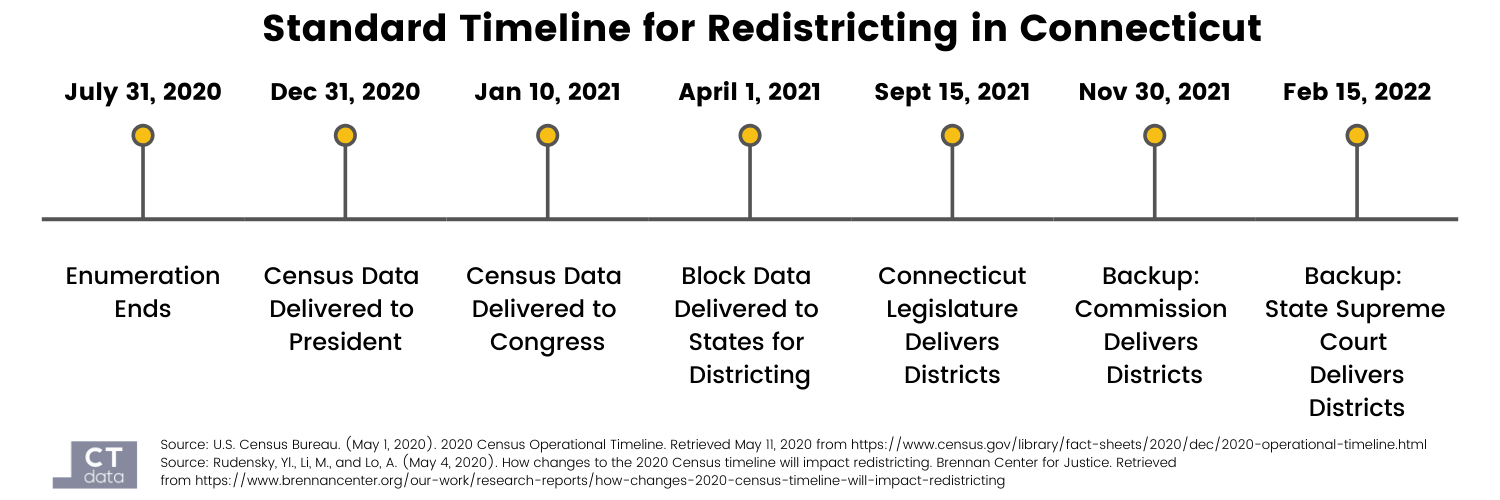
States receive two types of data. The first is the total population of each state and how many congressional seats are apportioned to each state (how many U.S. House seats they get). This information is delivered to the president by December 31 in the year the census is taken. The president then delivers this to Congress within 7 days after the start of the session (by January 10 in 2021).
The second data is the block-level demographic data used by the states to draw district lines, also known as redistricting. This is typically delivered to states by April 1.
The state’s constitution defines the dates that district data must be delivered, along with the dates for backup redistricting if each date is not met. Brennan Center for Justice notes that the Connecticut Legislature is required to update and deliver the districts to the governor by September 15. If the legislature is unable to do so, a backup commission is required to deliver the districts by November 30, and if that is not delivered, the state Supreme Court will draw temporary maps by February 15 of the following year.
The original timeline typically gives the Connecticut Legislature five months to redraw districts for both congressional districts (U.S. House seats) and legislative districts (Connecticut House and Senate seats).
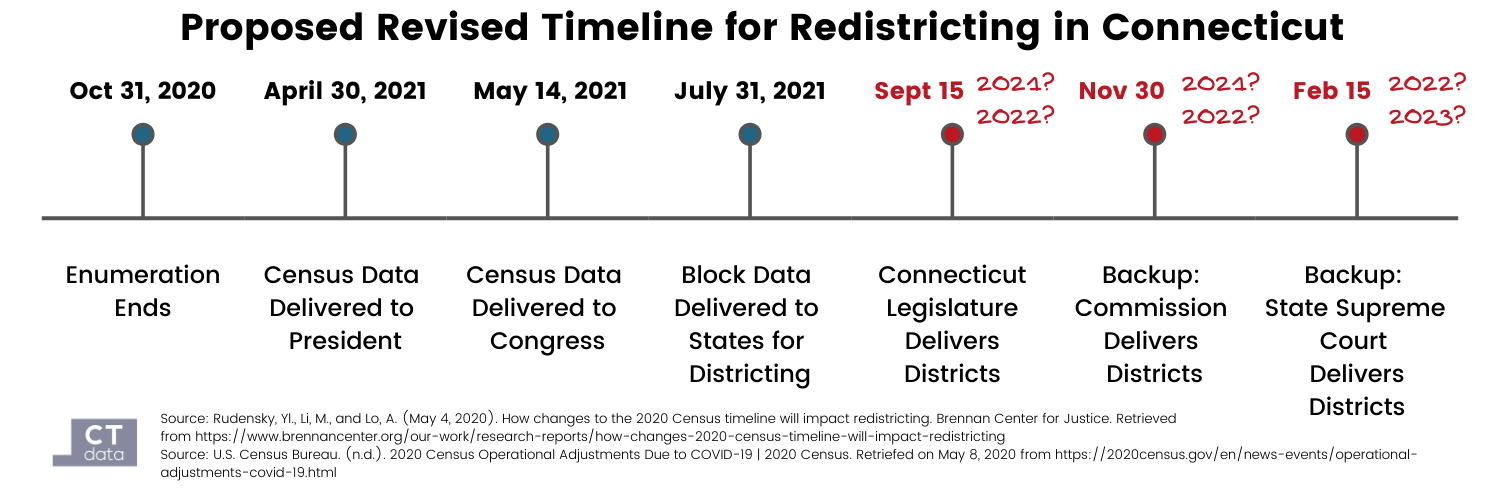
This year, due to COVID-19, census response (enumeration) won’t end until October 31, pushing back all other data delivery. Since the block data might not be delivered until July 31, Connecticut would have only two months to redraw district lines, depending on if there is flexibility in how the ‘year’ is interpreted in the state constitution.
The question is whether the redistricting must occur “in the year after the census is taken (2020)” or in the “year after the Census Bureau delivers” the data for redistricting, which would be 2021.
According to the Brennan Center for Justice, this timeline is an interpretation of Article III § 6(a) and XXX § 2(a) of the Connecticut Constitution that requires redistricting in the “next following” year of the decennial census.
The people of Connecticut don’t need a partisan battle or the court settling our districts. What we need is accurate representation for all of our communities, and to do this, the state will need to clarify the constitutional requirement and make adjustments if necessary.