
May is Asian/Pacific American Heritage Month – a celebration of Asians and Pacific Islanders in the United States. In Connecticut – according to the 2020 U.S. Census – the Asian/Pacific American population grew by 27.1% during the past decade, from 134,091 residents in 2010 to 170,459 in 2020.

The communities with the largest number of Asian/Pacific Americans in Connecticut are Stamford (11,453), New Haven (9,044), Manchester (6,249), West Hartford (5,693), Danbury (5,339), South Windsor (4,941), Norwalk (4,772), Greenwich (4,726), Hartford (4,208) and Bridgeport (4,024), according to 2020 U.S. Census data.
Between 2010 and 2020, the number of residents of Asian/Pacific American heritage more than doubled in nine Connecticut cities and towns, including Ellington (from 515 to 1,251), South Windsor (from 2,075 to 4,491), Rocky Hill (from 1,936 to 3,997), and Avon (from 1,141 to 2,318).
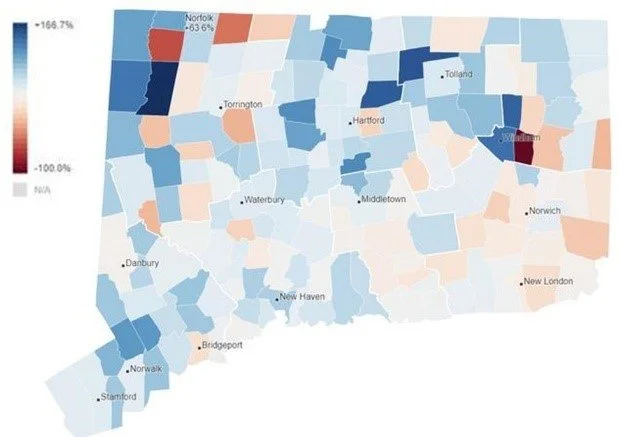
A total of 26 Connecticut communities have more than 2,000 residents of Asian/Pacific heritage, according to the 2020 Census, compared with 21 towns and cities in 2010. There are twice that number – 52 communities in Connecticut – with fewer than 100 Asian/Pacific American residents, the Census found.
The Census data also indicates that in 44 of the state’s 169 municipalities the population of residents of Asian/Pacific heritage dropped during the decade, including East Hartford (-21.3%), Groton (-16.1%), Bridgeport (-15.8%) and Norwich (-7.6%).
An interactive data map on the Connecticut Data Collaborative website enables the public to research and review the population trends from the most recent census, and its predecessor in 2010. The data map can be seen at www.ctdata.org/census-2020-explorer-page . Available data includes an array of additional demographics, by city and town.
“Making data accessible and sharing data on the diversity of our residents is an essential element in better understanding our state,” explained Michelle Riordan-Nold, Executive Director of the CT Data Collaborative. “As Connecticut’s population continues to evolve, having the data is important for decision-making.”
Among communities with more than 1,000 residents of Asian/Pacific heritage as of the 2020 Census, those with the greatest percentage increase in the previous decade are Ellington (+142%), south Windsor (+138%), Rocky Hill (+106%), and Avon (+103%).
The 2020 Census also indicated that Connecticut’s Latino or Hispanic population grew by 30.1% to 623,293; Black population increased by 7.7% to 360,937; and population of White residents dropped by 10.5% to 2,279,232.
Asian/Pacific encompasses all of the Asian continent and the Pacific islands of Melanesia (New Guinea, New Caledonia, Vanuatu, Fiji and the Solomon Islands), Micronesia (Marianas, Guam, Wake Island, Palau, Marshall Islands, Kiribati, Nauru and the Federated States of Micronesia) and Polynesia (New Zealand, Hawaiian Islands, Rotuma, Midway Islands, Samoa, American Samoa, Tonga, Tuvalu, Cook Islands, French Polynesia and Easter Island). As with most commemorative months, Asian/Pacific American Heritage Month originated with Congress, three decades ago.
For More Information
If you are interested to learn more about CTData, check out what we do and the services we provide. For training and tips on how to use data to inform your personal and professional life, register for one of our CTData Academy workshops or browse our blog. You can keep up with us by subscribing to the CTData newsletter and following us on Twitter, Facebook, and LinkedIn.