
With 111 days until Census Day 2020 (April 1, 2020), the clock is ticking and communities must be ready to count everyone. That was the message that reverberated throughout the room during the December 10th Connecticut Complete Count Committee meeting, held at the State Capitol. This meeting brought together state leadership, Local Complete Count Committee (LCCC) representatives, service organizations, funders, and Census Bureau staff to brainstorm how to reach hard-to-count populations such as young children, those living in group quarters, and immigrant communities.
Connecticut is already leading the nation in efforts to plan for the 2020 Census, thanks to the great leadership of the Statewide Complete Count Committee, which is chaired by Lieutenant Governor Susan Bysiewicz and co-chaired by Secretary of the State Denise Merrill, State Representative Christopher Rosario of Bridgeport, and State Representative Pat Wilson Pheanious of Ashford. In addition the the statewide committee, Connecticut boasts 116 Local Complete Count Committees, which are cross-sector partnerships coordinating the on-the-ground Census 2020 efforts. Connecticut has also secured $1 million in funding for the 2020 Census from the state and local funders.
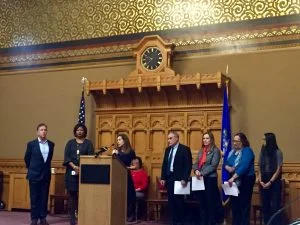
During the meeting, representatives from Local Complete Count Committees (LCCCs) shared some of the work they are doing in their communities to get the word out: the Census is safe, easy, and important, accounting for nearly $11 billion of Federal aid for Connecticut. It is also important because the Census will determine legislative districts and how many representatives the state will receive for the next 10 years. In fact, it is estimated that for every person not counted, Connecticut loses $2,900 in funding. That’s right. A form that takes about 5 minutes to complete will determine Federal funding and representation from 2020-2030. This is why counting everyone in our state is so important!
Representatives from Local Complete Count Committees (Sal Luciano, AFL-CIO; Representative Hilda Santiago, Meriden LCCC; Liz Porter, Town of Groton LCCC; Diane Nadeau, Windham Chamber of Commerce) reported a variety of innovative ways that they are coordinating efforts and spreading their work in their communities. While their specific efforts differed, each representative highlighted the need to meet people where they are to complete the census. Outreach efforts include:
-
Passing and disseminating a resolution to union members during the annual convention, sharing the importance of the census.
-
Videotaping key leaders talking about the census.
-
Collaborating with media specialists to get the message out in multiple languages.
-
Holding job fairs to recruit local census enumerators.
-
Hosting meetings with immigration advocates.
-
Holding a Census 2020 poster contest in local schools.
-
Hosting information sessions on the military base, in senior centers, and at schools.
-
Hosting Census 2020 parties on April 1st at libraries and other trusted institutions where people can go and use technology to complete their form and ask any questions.
-
Provide census messaging at all existing events.
-
Disseminating census information in existing newsletters, mailings, in paycheck envelopes, and on social media.
-
Posting information in key locations such as lunch and break rooms, religious institutions, sports clubs, and doctor’s offices.
While much work has been completed, attendees expressed some concerns about current outreach efforts. Local Complete Count Committees shared a need for:
-
Funding to develop and print outreach materials and host Census 2020 events.
-
Guidance about “best practices” for outreaching to hard-to-count populations.
-
Literature and materials developed at appropriate literacy levels and in multiple languages.
-
Coordinated information sharing across LCCCs to streamline efforts and feel like they are not working in isolation.
For more ideas about how to engage your community in Census 2020, view our previous blog summarizing the recent Census 2020 Ideation Workshop. You can also sign up for our CTData newsletter to receive updates about the 2020 Census.