
The 2020 Census Detailed Demographic and Housing Characteristics-A (Detailed DHC-A) file, which provides population counts for 1,500 racial and ethnic groups, was released last week.
There are a few methodological changes to be aware of:
Hispanic Origin Data
The Census Bureau made changes to the way it collects race and ethnicity data in the 2020 Census. For a detailed look at the changes, read our blog post, “Recent and Proposed Changes in How the Census Bureau Collects and Processes Race and Ethnicity Data”.
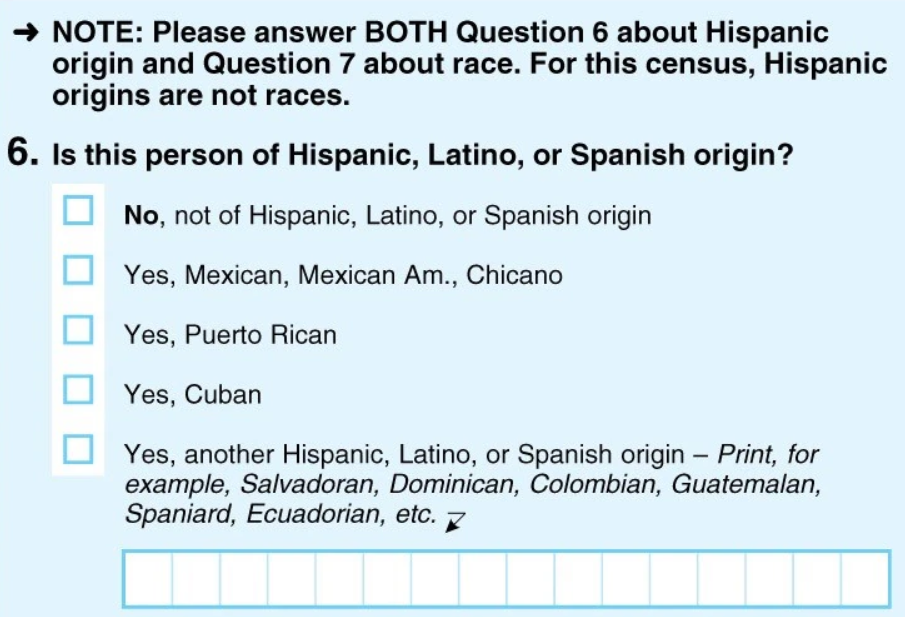
Hispanic origin data from tabulations of responses to race questions will differ from data tabulated from ethnicity questions. Hispanic origin data from the race question reflect only those who chose to write in that origin in the race question (under any of the race categories). Many people who identify as Hispanic or Latino may not have chosen to write their origin in the race question because the 2020 Census did not list Hispanic or Latino as a race category. On the other hand, the ethnicity question prompted respondents to select or write in their Hispanic origin. For this reason, data from the ethnicity question should be used for official counts of Hispanic origin groups.
To tell race and ethnicity data apart, note that race data will include “alone” or “alone in any combination” and ethnicity data will not. For example, “Puerto Rican alone” counts are race data, whereas counts that say “Puerto Rican” come from the ethnicity question.
Differential Privacy
The Detailed DHC-A file uses a different differential privacy algorithm, called Safe-Tab, than other 2020 Census data products which use the Top-Down algorithm. Data in the Detailed DHC-A file are therefore not consistent with other 2020 Census data products. With the Safe-Tab algorithm, aggregations of data from smaller geographies do not necessarily sum consistently to larger geographies. And, unlike the previously-released Redistricting Summary File and the Demographic and Housing Characteristics File, Detailed DHC-A data will not become more accurate as they are aggregated.
Here are Census Bureau resources that we’ve gathered to help guide you through using the data:
-
Accessing 2020 Census Detailed DHC-A Data on data.census.gov
-
Video about accessing Detailed DHC-A data
-
-
-
Chapter 4 for information about disclosure avoidance and differential privacy
-
Appendix B-2 for information about Race and Ethnicity Classification
-
Appendix B-3 for information about Hispanic or Latino Origin data
-
-
What You Should Know About the Upcoming Detailed Demographic and Housing Characteristics File A
-
Overview of data availability and coding methods
-
-
Population Data Available for 2020 Census Race, Ethnicity, and AIAN
-
How adaptive design and the differential privacy budget determined data availability
-
-
-
Information on data accuracy, availability, suppression, and creating custom calculations
-
-
-
Overview of changes to race and Hispanic origin questions between the 2010 and 2020 Censuses
-
-
2020 Census Hispanic Origin and Race Iterations List (.xlsx file)
-
List of detailed and regional groups available in the Detailed DHC-A
-
-
2020 Hispanic Origin and Race Code List (.xlsx file)
-
How responses to the Hispanic origin question and the race question were coded
-
-
2010 to 2020 Detailed Race and Ethnicity Crosswalk (.xlsx file)
-
Outlines which codes were used to tabulate each group in the 2010 Census and 2020 Census
-
If you are interested in learning more about CTData, check out our mission and values and the services we provide. For training and tips on how to use data to inform your personal and professional life, register for one of our CTData Academy workshops or browse our blog. You can keep up with us by subscribing to the CTData newsletter and following us on Twitter, Facebook, and LinkedIn.