
Data shouldn’t be confined to a spreadsheet. Don’t get us wrong—we love a good spreadsheet as much as the next data person, but when endless rows and columns of data overwhelms rather than informs, it’s not serving its highest purpose to help improve outcomes and inspire change.
At the Connecticut Data Collaborative (CTData), our goal is not only to make data available but accessible for everyone to understand and use. This is why we are excited to introduce a new project that includes data you can’t find anywhere else: the Connecticut New Business Registrations in 2020 dashboard.
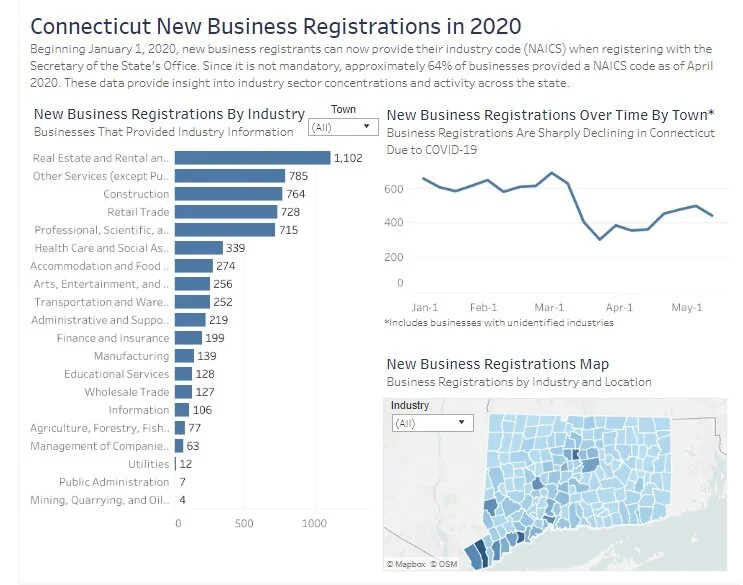
You might have learned in our blog post last month that week-to-week drops in 2020 Connecticut business starts surpassed that of the Great Recession. To dive deeper into this issue, we created this dashboard using data from the Connecticut Secretary of State that hasn’t been published before in our state: business starts by North American Industry Classification System (NAICS) codes.
Beginning on January 1st, 2020, new businesses can include their NAICS code when they register with the Connecticut Secretary of the State. NAICS codes represent business industries, and about 64% of businesses included their NAICS code. It’s not mandatory to provide this information, as some owners might not know the specific code for the business. However, this data is currently the best available to deepen our understanding of Connecticut’s economy during this unprecedented time.
To easily pinpoint concentrations and activity, our dashboard allows you to view new businesses by industry for each of Connecticut’s municipalities, and our interactive map illustrates the locations of industry hotspots. You can also see how new business registrations have changed over time for each town, which helps visualize Covid-19’s impact on business starts.
The highest activity by NAICS code is in the real estate, rental, and leasing sector. Stamford, Bridgeport, and Glastonbury had the highest number of new businesses registered with this NAICS code. We must approach this data carefully, as some of the activity are truly new business formations, but some are not quite what people would consider a new business. Builders put individual houses into LLCs, so the sector appears more active, but it could be the building of a housing development. This process is still considered business activity, but counting houses isn’t the traditional way to measure it. Also, LLCs can be formed for real estate tax purposes and don’t represent new business formation. As one of the essential industries during this crisis, construction also ranks in the top three of new business registrations, with the highest concentration in Danbury.
New business registration data is just one part of a much larger narrative. Although new business registration data can’t answer all of our questions, it encourages us to ask new ones to understand economic activity from a different perspective. Though no one can predict the future, especially in a time of uncertainty, data provides key insights into rapidly-changing landscape.
Interested to learn more about new business registrations across the state? Head to the Connecticut New Business Registrations in 2020 dashboard and let us know what you think at info@ctdata.org or reach out to us on Twitter, Facebook, or LinkedIn. We’ll continue to keep track of this information, so make sure you don’t miss an update by signing up for our newsletters.