
This is a landmark decade for women in the labor force. Women represent nearly half of the labor force both nationally (47.2%) and in the state of Connecticut (48.6%). In addition, according to the Wall Street Journal, 2019 marks “the first year that women make up the majority of the college-educated labor force, a milestone that is already altering benefits packages offered by companies.” These changes are insightful given that labor force participation is even higher when we look at women who have had a child in the past 12 months.
A recent analysis of the 2017 American Community Survey by the Census Bureau found that 63.2% of women in the U.S. ages 15 to 50 who gave birth in the last 12 months were in the labor force: employed, on leave from work, or unemployed. The percent in Connecticut is higher, with nearly 3 in 4 of these women in the labor force (73%). This raises questions such as – what women are participating in the workforce and how can our states and communities better support these working women.
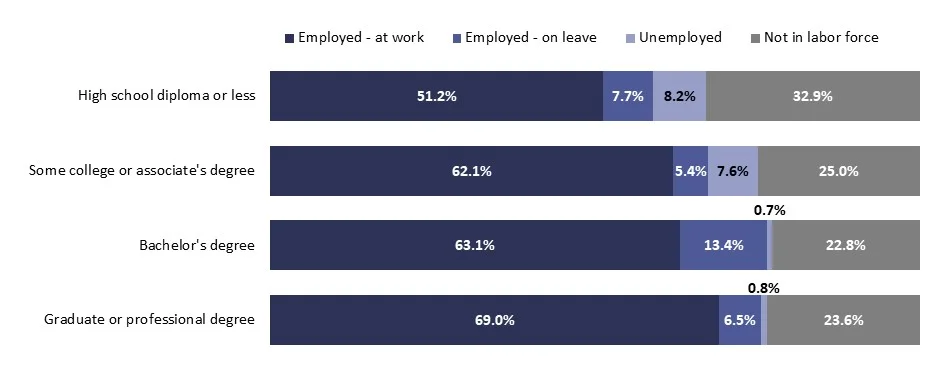
One perception is that highly educated and high-earning women exit the labor force to have children. This is not the general trend. When we look at involvement in the labor force by educational attainment, we see that recent mothers with higher education are actually more likely to be in the labor force and less likely to be on leave from work. Across the United States, 81% of recent moms with a graduate or professional degree are in the labor force (71.2% working, 9.2% on leave, 1.5% unemployed). The story is similar in Connecticut with 76% in the labor force (69% working, 6.5% on leave, 0.8% unemployed).
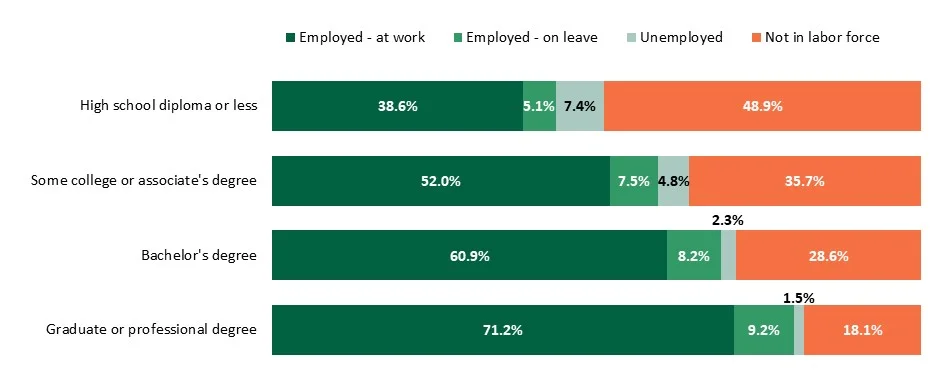
One notable difference between the national and state findings is that Connecticut has 31.3% more recent moms in the labor force with a high school diploma or less (67.1% CT, 51.1% US). Connecticut also has almost twice the percentage of recent moms with a bachelor’s degree on temporary leave from work than the national figure (13.4% CT, 8.2% US). While we are unable to determine why these differences exist in our state compared to the US from these data alone, it is worth investigating. Understanding the makeup and trends of women in the workforce can help policymakers shape programs and policies that support the needs of women and families.
Data for this analysis comes from the U.S. Census Bureau’s American Community Survey (ACS) 1-year estimates, 2017 and was analyzed using IPUMS USA, University of Minnesota, www.ipums.org. This is just one example of the many ways that individuals and organizations in CT can use public data to understand their communities. As part of CTData’s commitment to increase data literacy and build data capacity across the state, we offer workshops and trainings through the CTData Academy. Contact us at info@ctdata.org if you would like to learn more about how to use census data through data.census.gov or IPUMS. More information on the CTData Academy, CTData programs and events, and publicly available datasets can be found on our website atctdata.org.