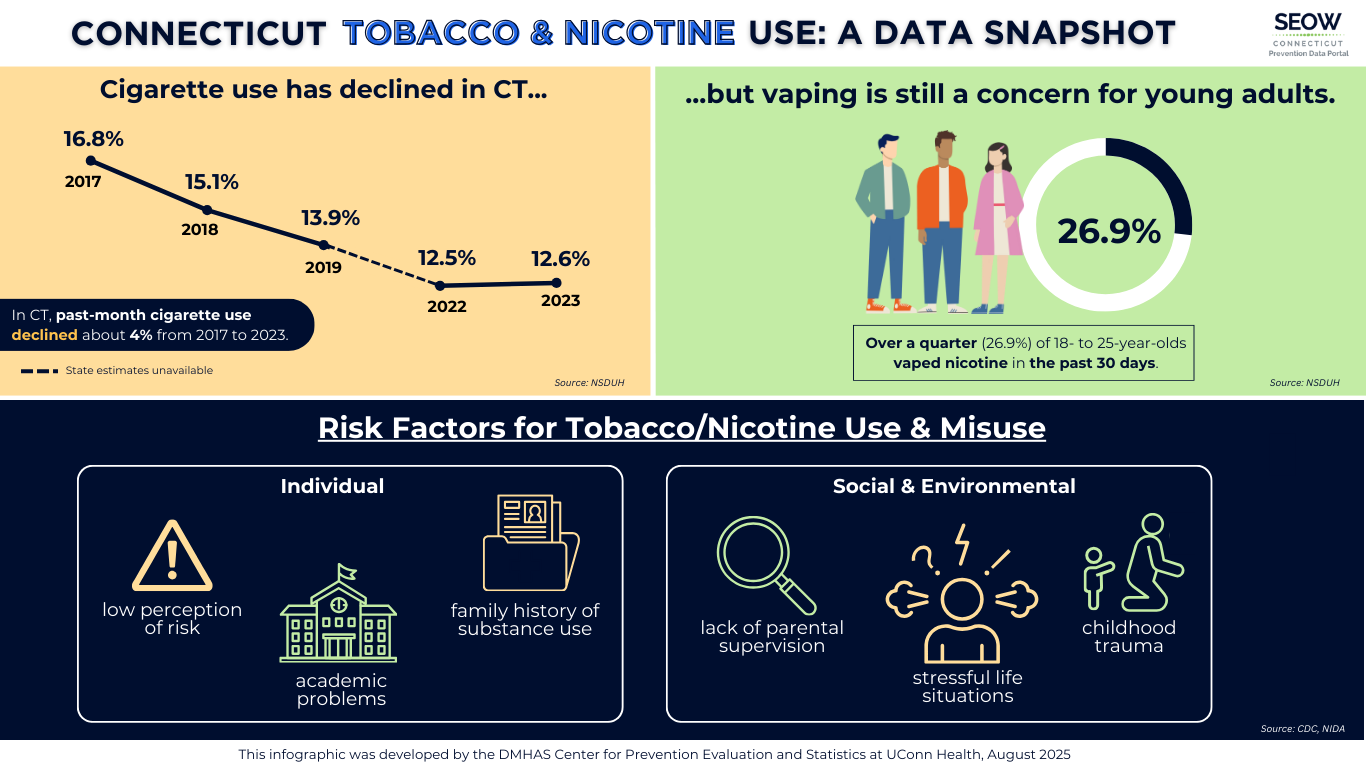
Click on the image to access the full epidemiological profile.
Visualizations
A direct link to the visualization to share or embed can be found here. To enlarge a specific visualization, hover over the top right corner and click the button.
Data Resources
The products developed by CPES and its prevention partners include presentations, fact sheets, maps, charts, and other graphic representations of data, as well as guidance and resource documents. Products are provided with the goal of making data accessible to all users, regardless of their data skills or knowledge.
The products in this section are free for use, with the proper attribution of data sources, listed authors, and the SEOW Prevention Data Portal.
DrugFreeCT Substance Info: Tobacco & Vapes
DrugFreeCT website substance information page on Vaping and Tobacco, including an overview and information on short- and long-term effects, nicotine addiction and withdrawal, and special topic tiles on CT vaping prevalence and trends, prevention, treatment, and frequently asked questions (FAQs), as well as other resources.
Explore Vaping Data
Along with the visualizations provided above, you can also explore and download raw datasets using the links below.
CT Behavioral Risk Factor Surveillance System (BRFSS)
An ongoing voluntary telephone survey of adults 18 and older conducted in all 50 states and coordinated by the Centers for Disease Control and Prevention (CDC). Connecticut’s BRFSS is managed by the CT Department of Public Health, and collects data on health risk behaviors, health care access, utilization of preventive health services, and some emerging health issues.
Connecticut School Health Survey (CSHS)
Connecticut’s version of the CDC Youth Risk Behavior Survey (YRBS) that captures data on health behaviors as well as school and social environments among Connecticut high school students in grades 9 to 12.
DataHaven Community Wellbeing Survey (DCWS)
A statewide community-focused survey of CT residents, conducted by DataHaven, that collects data on various indicators, such as health behaviors, quality of life indicators, and indicators related to social determinants of health. Results are analyzed by demographic groups as well as community types, using the Five Connecticuts typology.
Access Our Entire Data Indicator Library!
Our Data Indicator Library is a downloadable workbook that provides a comprehensive list of prevention indicators and datasets. The Data Indicator Library is updated and maintained by the Center for Prevention Evaluation and Statistics at UConn Health.